Bela Gem Stereo and Bela Gem Multi are two new Bela boards based on the PocketBeagle 2. They were launched on CrowdSupply today at https://bela.io/gem were you can place your order. Boards ship from the US, because that's how Mouser/CS does their fulfillment. The good news is for the EU, UK, AU, NZ, CA (and possibly more?) you will be charged for local VAT at checkout and will receive an invoice from their subsidiary in your country, so no surprise import fees will be due on delivery.
These boards represent a big step forward from the first generation Bela and BelaMini: they are based on the PocketBeagle 2, which sports a quad-core 1.4GHz Cortex-A53 processor, i.e.: much more processing power for your Bela applications (at virtually no extra electrical power cost! (see below)). All details can be found at https://bela.io/gem, but I'll elaborate a bit here.
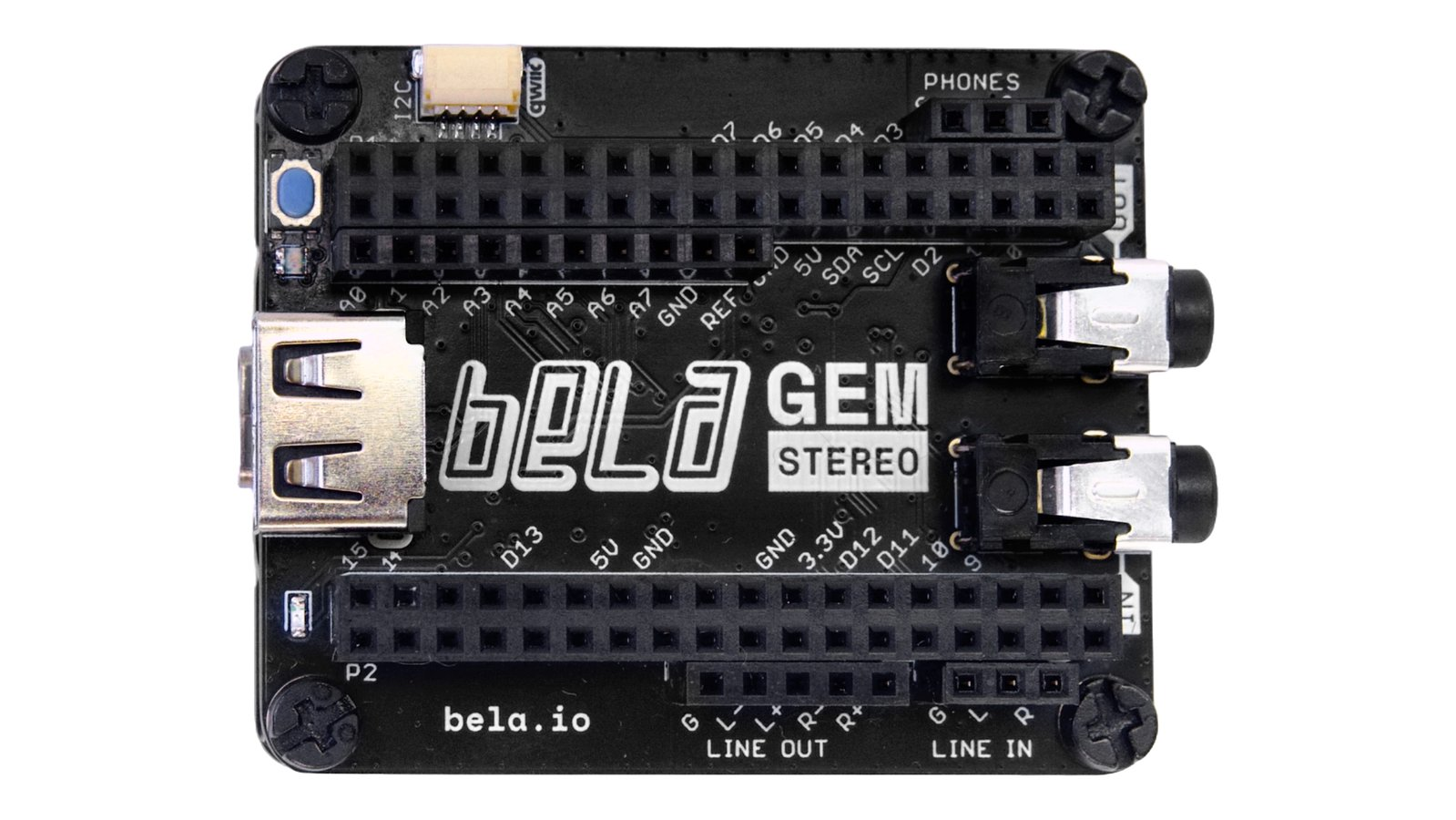
The Stereo is the successor of the BelaMini (the PocketBeagle that the Mini was based on has been discontinued for a while): stereo audio I/O, 8 analog ins, 16 digital I/O. It has a slightly larger footprint to accommodate the mounting holes, so we took advantage of that to add a Qwiic connector as they seem to have become pretty standard these days (even the latest Trills have them). The PB2's USB-C port makes for a more reliable connection and additional power handling. We decided to get rid of the Molex-to-jack-socket adapters and instead provide on-board jack sockets. In order not to limit the connectivity options, all audio signals are also available on the headers, so that you can use your custom connector of choice.
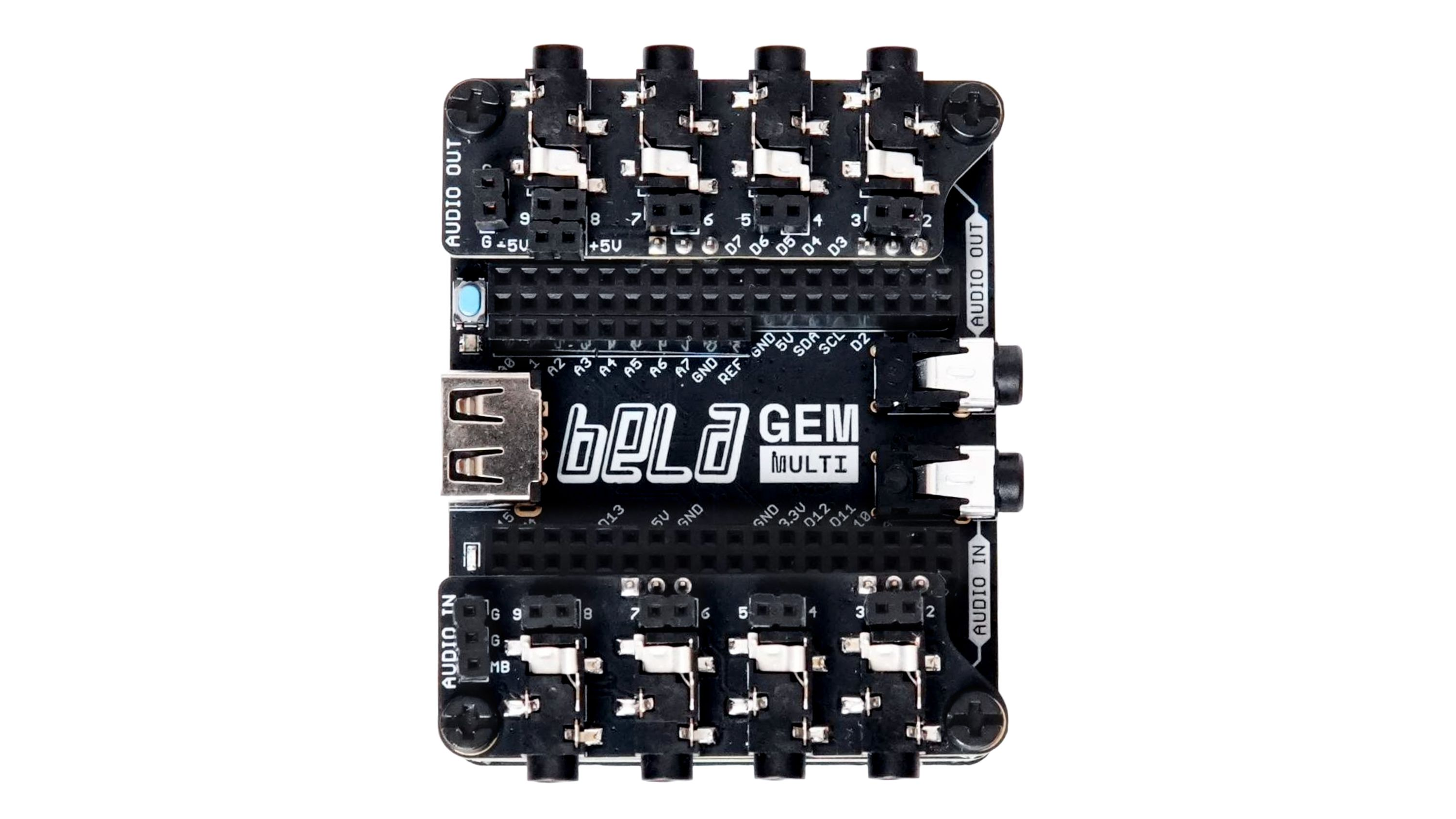
The Multi is some sort of a merge between the Bela Rev C cape and our existing multichannel offering, expanding on both fronts. It provides 10 audio I/O, 8 analog ins, 16 digital I/O.
8 of the audio outputs are DC-coupled. They replace the "analog outs" of the Bela cape but can do much more: the output voltage range is ±5V and so they are great as dual-purpose audio or CV. They use the ESS ES9080Q DAC, a sigma-delta audio DAC with impressive specs. The extra audio inputs are provided by a pair of TLV320ADC3140, a great 4-channel ADC with per-channel adjustable gain.
The first two channels of audio inputs and outputs are available on the main board as 3.5mm THT jack sockets; the remaining channels are broken out to two headers on the main board. The "wings", two add-on boards that are mounted on top of the main board, provide SMT 3.5mm jack sockets for these signals. The wings are provided as a convenience feature, but are optional: when embedding the board you may want to access the audio signals on the headers and route them to your connector of choice. While the signals on all jacks are unbalanced, differential signals for all input channels and for the main stereo outputs are available on the headers.
Besides the Qwiic, the Multi also has a 2-pin JST battery connector. That didn't fit on the Stereo, so there you have to look for the correct pins on the headers to connect you battery.
The USB host port on both capes is still a USB-A. In this long transition phase between USB-A and USB-C, it's unclear whether USB-C would have had a clear advantage there, where you are most likely to connect a WiFi dongle or a USB MIDI controller. We found a small enough connector USB-A connector that fit on the footprint and so we went for that.
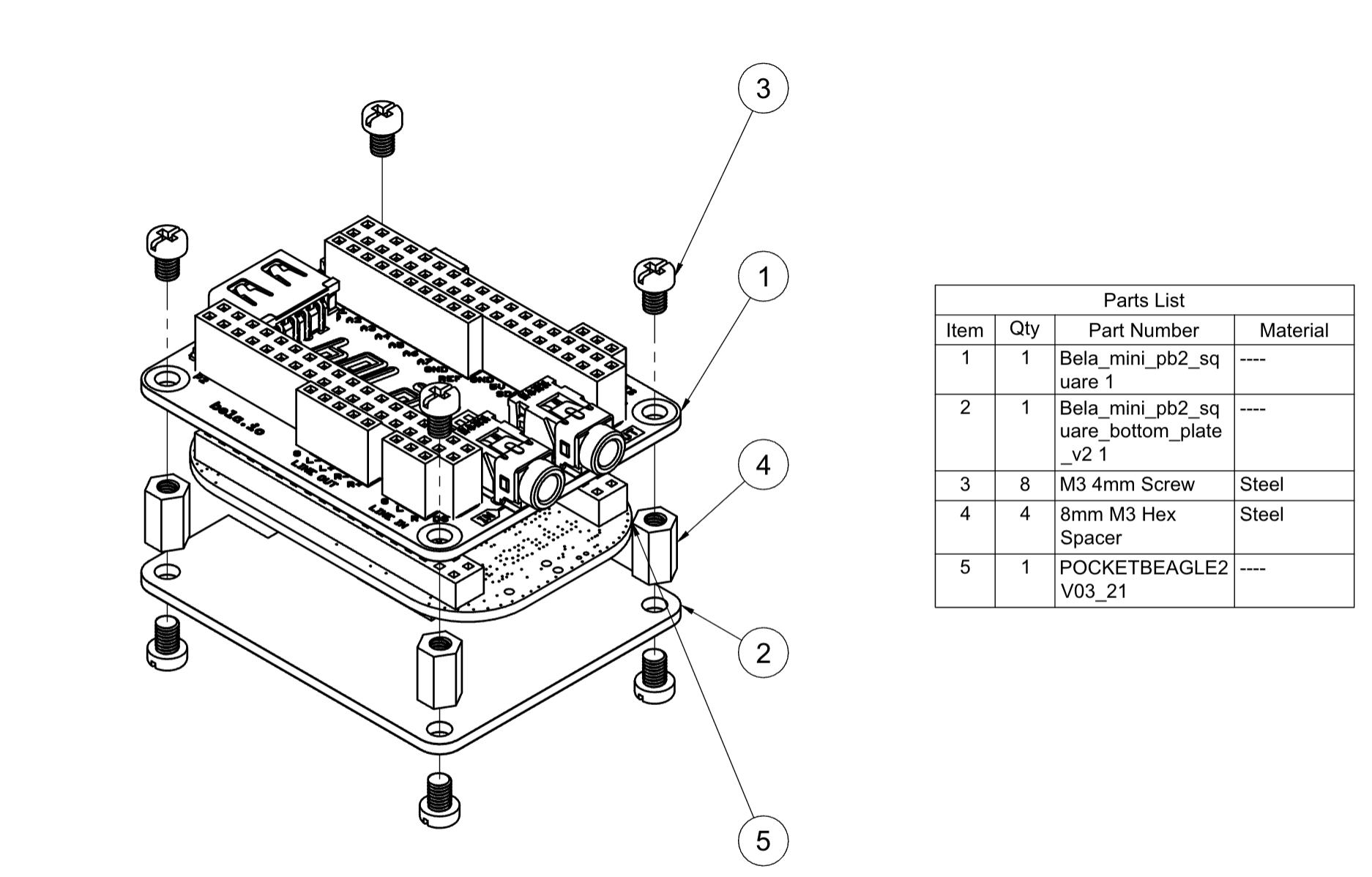
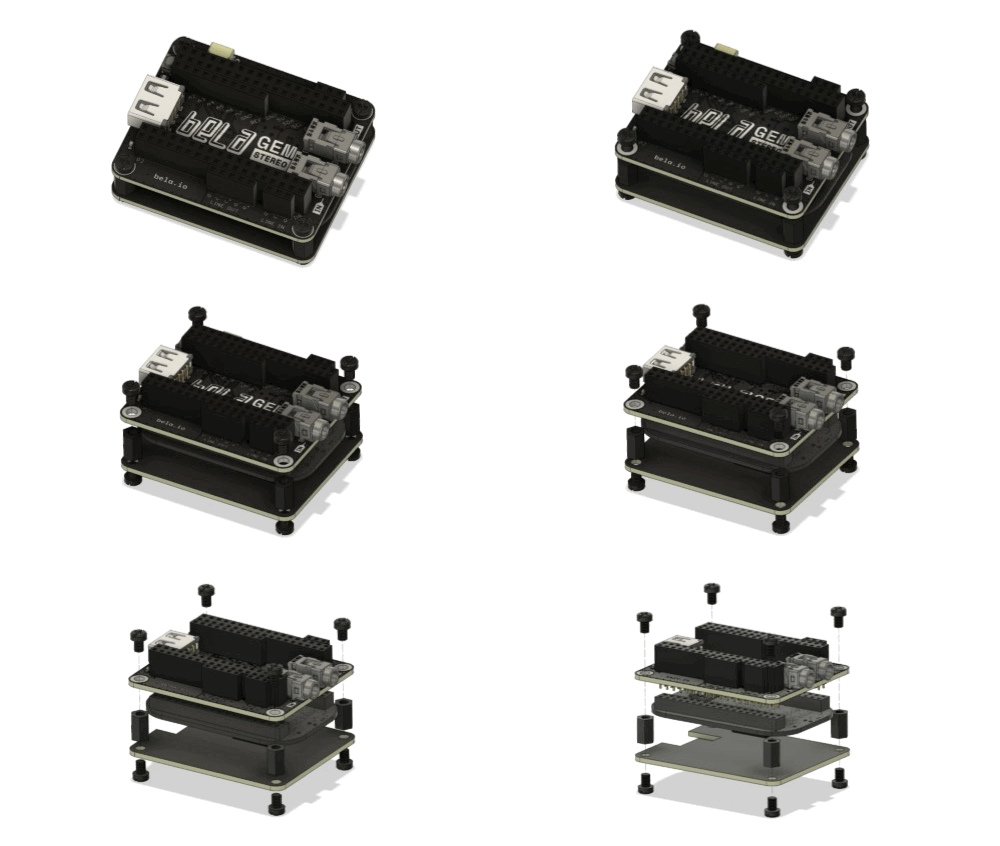
The PocketBeagle 2 was designed to be mounted with the headers facing down and the expansion boards placed below it, but we actually need our cape to be on top, so we turned the PB2 upside down. We provide mounting holes, spacers and a bottom plate that can protect the PB2 while the device is sitting on your desk, while leaving its buttons accessible. Here's an exploded view of the BelaGem Stereo:
Most software you've been writing for first-generation Belas using the provided API should run without modifications. The only difference is in case you were using analogWrite() or analogWriteOnce() on the Bela cape, in which case you need to switch to audioWrite() on the Multi. We will release a new IDE when the boards ship which is a full rewrite and comes with several improvements. Most notably, it will use clangd for live syntax checking and context-aware suggestions. This same IDE will replace the old one also on the older boards (possibly without clangd, depending on which image version you use).
Hardware-wise, most things have moved place in comparison to BelaMini. The PB2 is "upside down" with respect to the PocketBeagle (at least with respect to the way we used the latter), this means that P1 and P2 are mirrored, including placement of 3.3V and 5V pins (dangerous!). So, as a general rule: do not connect a Gem in place of a Bela Mini. Check the new pinout instead.
Power consumption: perhaps surprisingly, power consumption has barely increased at all over the first generation boards: with the four cores spinning at 100% and the Bela program running, I measured only 60mW more on the GemMulti than on a Bela board running a Bela program, and the former comes with 8 extra inputs! That's great also in comparison to the >8W you get when running a Pi 5 at full clock. For the Gem and the PB2: no heatsink needed, no fan needed, don't be afraid of enclosures (though a bit of ventilation won't hurt as usual). See here).
Pepper users: we see you. As soon as we'll have a chance to work on it, we'll provide an adapter board that allows you to upgrade your existing Pepper to use a PocketBeagle 2 instead of the BBB, providing a cost effective upgrade path.